
Pipe Clamp
A constructor assembles a fence, shelving, or technological frame from pipe and chooses between welding and modular assembly on clamping connectors. Externally, both options give an identical frame, but they are held on different principles.
Modular assembly is held by friction and tightening torque, and not by a continuous seam. Next we analyze which pipe clamp is suitable for a joint, how a modular frame differs from a welded one, and why tightening cannot be done by eye. Suitable options are collected in the catalog: https://elesaganter.com.ua/zatiskni-ziednuvachi/zazimnje-soediniteli-dlja-trub.
Types of pipe clamping connectors
A pipe clamping connector refers to several parts that assemble a frame without welding. A straight connector continues the pipe along one axis, and a corner one changes direction, usually by ninety degrees. A tee connector adds one side branch from the main pipe, and a cross one adds two branches at once in opposite directions. A flange connector works differently: it attaches the pipe not to another pipe, but to a flat base, floor, wall, or machine frame.- Straight: continuation of the pipe along one axis
- Corner: turn, most often by 90°
- Tee: one side branch
- Cross: two branches in different directions
- Flange: attachment of the pipe to a flat base
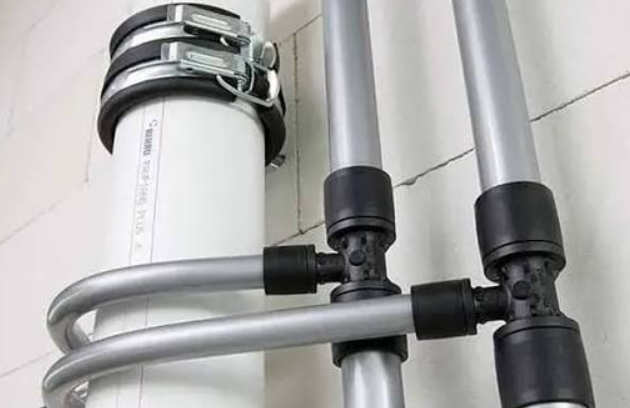 Modular frame vs welded frame
A welded frame holds its shape rigidly, but this rigidity is one-time. Changing the geometry or disassembling the structure for moving is possible only by cutting metal. A frame on clamping connectors is arranged differently. Each joint is held by a tightened screw, so it can be unscrewed, the pipe moved to a new length and reassembled, and this does not make such a frame weaker than a welded one. Modular assembly is convenient where the structure changes, for example test benches or fences of temporary zones. Where the geometry does not change for years and the frame does not need to be transported, the welded option is simpler and cheaper.
Tightening torque and thin-walled pipe
A clamping connector holds the pipe by friction, and friction is created by the tightening torque of the screw. Each connector has its own torque range, and it is specified in the fastening documentation. With weak tightening, the clamp turns around the pipe under load, the joint loses the set angle, and the screw eventually unscrews from vibration. Over-tightening is more dangerous, because it is not visible immediately. For a thin-walled pipe, excessive torque pushes the wall inward, and the pipe loses strength exactly at this compression point. Therefore, the tightening torque for a thin-walled pipe is taken at the lower limit of the range.
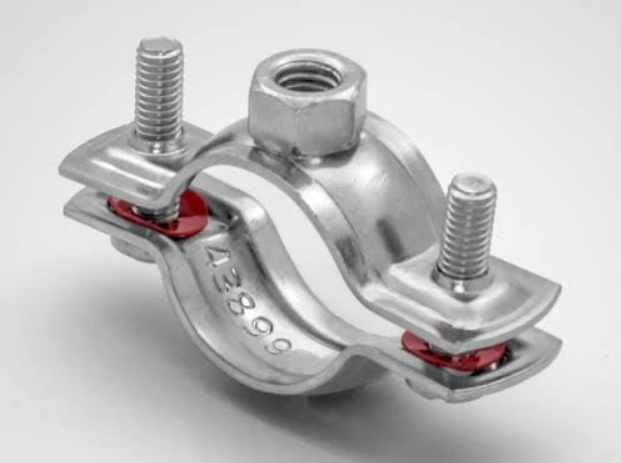
Selection by diameter and wall thickness
A clamping connector is selected by the outer diameter of the pipe, but here a second value is added, wall thickness. Thin-walled and thick-walled pipes of the same diameter are clamped with different torque, because a thin wall withstands less force before deformation. Therefore, in the catalog of clamping connectors, diameter and wall thickness are specified as separate parameters, and not as a single size. Before ordering, both values are measured on the pipe itself, and not taken from the general specification of the project. The surface of the pipe under the clamp is not painted and not lubricated, because both paint and lubricant change the coefficient of friction through which the connector holds the load. A painted or lubricated pipe is held by the clamp worse than the calculated value even with correct tightening torque.
46
25/09/2026