
Growing a money tree at home
The money tree, also known as the fat woman, crassula or Crassula ovata, is one of the most popular indoor plants, which is valued not only for its unpretentiousness, but also for its symbolic meaning. It is believed that this plant attracts financial well-being and luck to the house, which is why it has become a frequent guest in the interiors of apartments and offices.

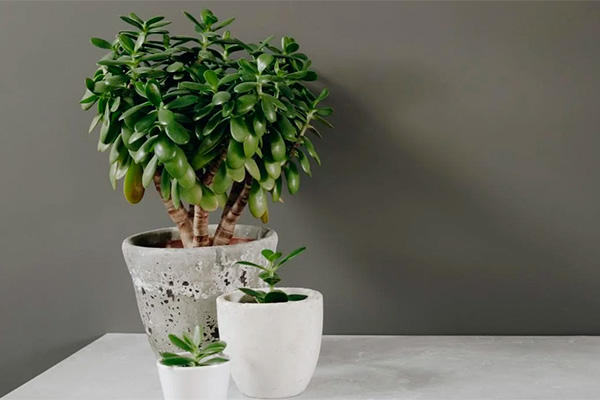
Native to South Africa, the money tree has adapted perfectly to home conditions. Its fleshy leaves, reminiscent of coins, and the tree-like shape of the trunk give the plant a decorative look, making it a real decoration of any space. In addition, the fat woman is famous for its ability to purify the air and positively influence the energy of the room.
In this article, you will learn how to properly care for the money tree so that it pleases you with its healthy appearance and, perhaps, even blooms. We will tell you about planting, watering, fertilizing, propagation and solving common problems that may arise when growing this amazing plant.
What is the scientific name of the money tree
The money tree, or fat woman, is a plant that has many names and varieties. Its scientific name isCrassula ovata(crassula oval or ovoid). It belongs to the Crassulaceae family and is a succulent, meaning it can store moisture in its leaves and stems, making it very hardy and undemanding.
Types of Money Tree
Although the most common type is Crassula ovata, there are many other varieties of Crassula that differ in the shape and color of the leaves, as well as in size:
-
Crassula ovata 'Hobbit'— a variety with unusual leaves that are curled into a tube, reminiscent of Shrek's ears.
-
Crassula ovata 'Gollum'— similar to 'Hobbit', but the tips of the leaves are expanded, like cups.
-
Crassula ovata 'Variegata'— a variegated variety with white and green leaves.
-
Crassula arborescens— has larger leaves with a reddish border.
-
Crassula perforata— an unusual species with leaves that seem to be strung on a stem.
Each of these species has its own characteristics, but they all retain the main features of the fat woman: fleshy leaves and the ability to survive in drought conditions.
How the money tree blooms
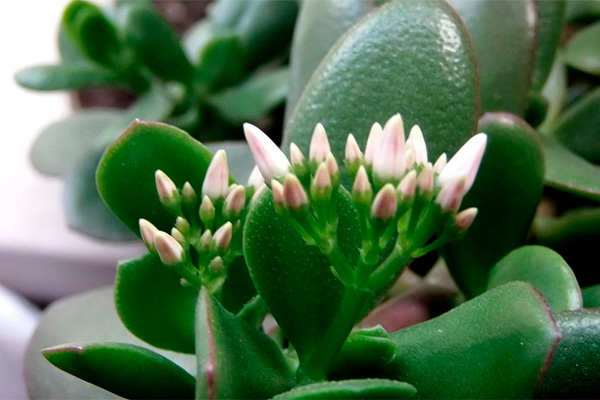
The flowering of the money tree is a rare phenomenon, but possible with proper care. This usually happens in winter or early spring. The flowers of the money tree are small, star-shaped, white or pink, collected in inflorescences. They have a pleasant but weak aroma.

To achieve flowering, it is important to provide the plant with a cool winter (temperature around +10...+15°C), moderate watering and sufficient light. However, even without flowers, the money tree remains a spectacular ornamental plant that decorates the interior with its juicy leaves and unusual shape.
Planting and soil
Correct planting and choice of soil are the first steps to successfully growing a money tree. Crassula, like other succulents, has special requirements for soil and planting conditions, which are important to consider so that the plant feels comfortable and pleases with its healthy appearance.
How to plant a money tree
Planting a money tree begins with choosing a suitable pot. Since the root system of the crassula is superficial and not too voluminous, the pot should be shallow but wide. This will ensure the stability of the plant, especially as it grows and becomes more massive.
Preparing the pot. Be sure to put a drainage layer (expanded clay, small pebbles or broken brick) on the bottom of the pot. This will prevent water stagnation and protect the roots from rotting. The drainage layer should occupy about 1/3 of the height of the pot.
Planting the plant. Carefully place the money tree in the pot, straightening the roots. Fill the roots with prepared soil, lightly tamping it. Make sure that the root collar (the place where the roots pass into the trunk) is not deepened too much, otherwise it can lead to rotting.
The first days after planting. After planting, do not water the plant immediately. Give him 2-3 days to adapt to the new conditions. Place the pot in a bright place, but avoid direct sunlight in the first days.

What kind of soil is suitable for a fat woman
The money tree prefers light, loose and well-drained soil. Heavy or too dense soil can lead to stagnation of moisture and rotting of the roots.
Soil composition:
- The ideal option is special soil for succulents and cacti, which can be bought in the store.
- If there is no ready-made soil, you can prepare the mixture yourself. To do this, mix:
- 2 parts leaf soil;
- 1 part coarse sand or perlite;
- 1 part peat or humus.
Soil acidity:
- Crassula prefers neutral or slightly acidic soil (pH 6.0–7.0).
To improve drainage, you can add a little fine expanded clay or charcoal to the soil.
If you use garden soil, be sure to disinfect it (for example, calcine it in the oven) to avoid introducing pests or diseases.
Caring for a money tree
The money tree is one of the most unpretentious plants, but for its healthy growth and beautiful appearance, it is important to follow the basic rules of care. The fat woman loves stability, so try not to overdo it with watering, fertilizing and other procedures. Here are the main aspects of caring for this plant.
Lighting and temperature
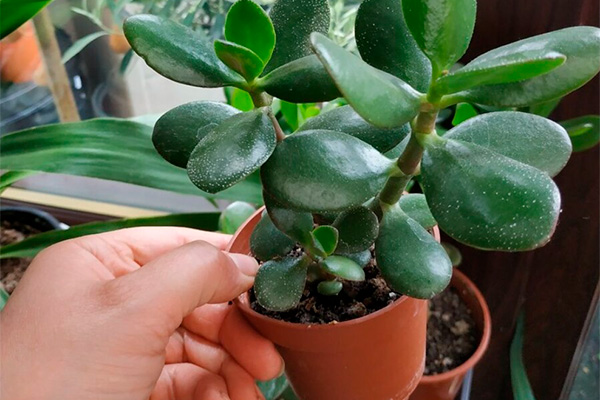
The money tree prefers bright but diffused light. The ideal place for it is a windowsill on the east or west side. On a south window, the plant needs to be shaded from direct sunlight, especially in summer, to avoid burns on the leaves.
Temperature. In summer, the optimal temperature for the fat woman is +20 ... +25 ° C. In winter, the plant needs cool maintenance at a temperature of +10 ... +15 ° C. This stimulates the dormant period and can promote flowering.
Important. Avoid sudden changes in temperature and drafts. Do not place the plant near heating devices in winter.
How often and what to water the fat woman with
Watering is one of the most important aspects of caring for the money tree. As a succulent, the fat woman tolerates drought better than overwatering.
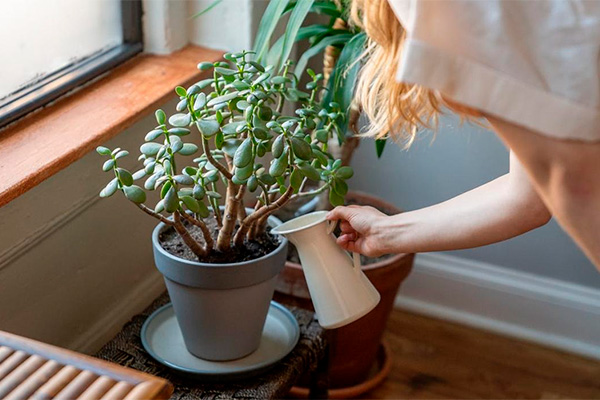
In summer. Water the plant moderately, about once every 7-10 days, after the top layer of soil has completely dried out. Use settled water at room temperature.
In winter. Reduce watering to once every 2-3 weeks, especially if the plant is kept in a cool room. Excess moisture in the cold season can lead to root rot.
Advice. If the leaves have become soft and have begun to wrinkle, this is a sign of a lack of moisture. If the leaves turn yellow and fall off, you may be over-watering the soil.
How to feed and fertilize Crassula
The money tree does not require frequent feeding, but during the period of active growth (spring and summer) it can be fertilized to maintain health and beauty.
Frequency of feeding. From spring to autumn - 1 time in 3-4 weeks. In winter, feeding is not required.
How to fertilize. Use special fertilizers for succulents and cacti. If there are none, universal fertilizers will do, but in half the dosage.
Important: Do not overfeed the plant, especially with nitrogen fertilizers, this can lead to to excessive growth and weakening of stems.

What does a money tree like at home
To make the fat woman feel comfortable, create the following conditions for it:
-
Stability: Avoid frequent rearrangements and abrupt changes in care.
-
Fresh air: In summer, you can take the plant out onto the balcony or into the garden, but protect it from direct sun and rain.
-
Clean leaves: Regularly wipe the leaves with a damp cloth to remove dust and improve photosynthesis.
Formation and pruning of the money tree tree
Formation and pruning of the money tree is not only an aesthetic procedure, but also an important stage of plant care. The fat woman tends to grow and lose shape, especially if it does not have enoughdoes not get enough light or it grows in unsuitable conditions. Proper pruning helps to create a beautiful crown, strengthen the trunk and stimulate the growth of new shoots.
Why is it necessary to shape a money tree
-
Aesthetics: Shaping helps to give the plant a neat, compact shape, reminiscent of a miniature tree.
-
Strengthening the trunk: Pruning stimulates thickening of the trunk, which makes the plant more stable.
-
Stimulating growth: Removing excess shoots promotes the appearance of new branches and leaves.

How to trim a money tree
-
Choose the right time. The best time for trimming is spring or early summer, when the plant is actively growing and easily restored.
-
Prepare the tools. Use sharp pruning shears or scissors pre-disinfected with alcohol.
-
Determine what needs to be trimmed. Remove long, thin or weak shoots that disrupt the shape of the plant. Trim branches growing inward to improve air circulation and light access. If the trunk has stretched too much, you can shorten it to stimulate growth of lateral shoots.
-
Pruning technique.Make cuts above a leaf node (the place where the leaf attaches to the stem). This stimulates the growth of new branches.
-
After pruning.Treat the cut areas with crushed charcoal or antiseptic to prevent infection. Do not water the plant immediately after pruning - give it 1-2 days to recover.
How to shape the crown
If you want the money tree to look like a miniature tree with a lush crown, follow these tips:
-
Start shaping from a young age. The earlier you start pruning and pinching the shoots, the easier it will be to give the plant the desired shape.
-
Pinch the tops. To stimulate branching, pinch the tops of the shoots, removing 1-2 pairs of leaves.
-
Turn the pot regularly.: To ensure that the crown develops evenly, turn plant once every 1-2 weeks at 90 degrees.
Bonsai-style formation
Crassula is great for creating miniature trees in the bonsai style. To do this:
-
Use wire to guide the growth of branches.
-
Regularly trim excess shoots to maintain a compact shape.
-
Replant the plant in a shallow pot to limit root growth.
Propagation of a money tree
Propagation of a money tree is a simple and fun process that allows you to get new plants from an existing one. Crassula is easily propagated in several ways: cuttings, leaves and seeds. The most popular and effective methods are cuttings and leaf propagation, as they require minimal effort and give quick results.
Propagation by cuttings
Cuttings are the most common method of propagating a money tree. It is suitable even for beginner gardeners.
-
Choose a healthy, strong shoot 8-10 cm long. It is best to use apical cuttings or lateral shoots.
-
Cut the cutting carefully with a sharp knife or scissors. Leave the cutting in a dry place for 1-2 days so that the cut dries out. This will prevent rotting.
-
Rooting:
-
In water. Place the cutting in a glass of water, immersing the lower part by 2-3 cm. Place the glass in a bright place, but avoid direct sunlight. In 2-3 weeks, roots will appear, and the cutting can be planted in soil.
-
In soil. Plant the cutting directly into prepared soil for succulents. Slightly moisten the soil and cover the cutting with a transparent bag or jar to create a greenhouse effect. In 3-4 weeks, the cutting will take root.
-
Propagation by leaves
This method takes more time, but it is also effective.
- Choose a healthy, fleshy leaf without damage.
- Carefully separate the leaf from the stem, trying not to damage it. Leave the leaf for 1-2 days so that the cut dries.
- Rooting:
- Place the leaf on the surface of the succulent soil, pressing its base lightly into the soil.
-
Moisten the soil with a spray bottle.
-
Cover the leaf with a transparent bag or jar to create a humid environment.
-
In a few weeks, small roots and new shoots will appear at the base of the leaf.
Propagation by seeds
This method is rarely used, as it is more labor-intensive and time-consuming.
- Use a light, loose soil for succulents.
- Evenly distribute the seeds over the surface of the soil. Lightly sprinkle them with a thin layer of sand. Moisten the soil with a spray bottle.
- Cover the container with seeds with transparent film or glass. Place in a warm, bright place, but avoid direct sunlight. Regularly ventilate and moisten the soil.
- The first shoots will appear in 2-3 weeks. When the seedlings get stronger, they can be transplanted into separate pots.
The best time for propagation is spring or early summer, when the plant is actively growing.
Use only healthy cuttings and leaves to avoid rooting problems.
Do not over-moisten the soil, especially when rooting leaves and cuttings.
Problems and their solutions
Even such an unpretentious plant as a money tree can encounter problems if the conditions of maintenance or care do not meet its needs. Most often, difficulties arise due to improper watering, lack of light or pests. In this section, we will look at the most common problems and tell you how to solve them.
Why the money tree turned yellow
Yellowing of leaves is one of the most common problems faced by owners of the fat woman. The main reasons:
-
Overwatering. Signs: the leaves turn yellow, become soft, and may fall off. Solution: reduce watering, let the soil dry out completely. If the roots begin to rot, replant the plant, removing the damaged parts.
-
Lack of light. Signs: the leaves turn pale and yellow, the plant stretches out. Solution: Move the money tree to a brighter spot, but avoid direct sunlight.
-
Nutrient deficiency.Signs: Leaves turn yellow, growth slows down. Solution: Feed the plant with fertilizer for succulents.
Why the money tree is not growing
If the money tree has stopped growing, this may be due to several factors:
-
A cramped pot.Signs: The roots have filled the entire volume of the pot, the plant looks depressed. Solution: transplant the plant into a larger pot.
-
Lack of light.Signs: the plant is stretching, the leaves are becoming smaller. Solution: provide bright but diffused light.
-
Lack of nutrients.Signs: growth is slowing, the leaves are losing their rich color. Solution: add fertilizer for succulents.
Leaves are falling off
Leaves falling off is a signal that the plant is stressed. Main reasons:
-
Overwatering. Signs: leaves become soft and fall off. Solution: reduce watering, let the soil dry out.
-
Overdrying soil. Signs: leaves wrinkle and fall off. Solution: increase the frequency of watering, but do not overdo it.
-
Sudden changes in temperature. Signs: leaves fall off for no apparent reason. Solution: avoid drafts and sudden changes in temperature.
-
Stress after transplanting. Signs: leaves fall off soon after transplantation. Solution: give the plant time to adapt, do not water it for the first few days.
Other possible problems
-
Soft leaves. Cause: overwatering or root rot. Solution: reduce watering, check the roots and replant if necessary.
-
Brown spots on the leaves. Cause: sunburn. Solution: move the plant to a place with diffused light.
Medicinal properties of the money tree
The money tree (crassula) is valued not only for its decorative qualities, but also for medicinal properties. This plant is widely used in folk medicine due to its anti-inflammatory, antibacterial and healing properties. However, it is important to remember that the use of the fat woman for medicinal purposes requires caution, since the plant contains substances that can cause allergic reactions or poisoning if used incorrectly.
Precautions
-
Consult your doctor before using the money tree for medicinal purposes.
-
Do not take the juice of the fat woman internally, as this can cause poisoning.
-
Check if you are allergic to the plant: apply a little juice to your skin and wait 15-20 minutes. If irritation occurs, discontinue use.
-
Keep the plant out of reach of children and animals.
Interesting facts about the money tree
The money tree is not just a beautiful and unpretentious plant. It is surrounded by many interesting facts, legends and superstitions that make it even more attractive to gardeners. In this section, we will tell you about the most curious moments associated with the fat woman.
Why is the money tree called the "silent killer"
Despite its harmless appearance, the money tree has a reputation as a "silent killer". The juice of the fat woman contains arsenic compounds, which can be dangerous if ingested. Consuming the leaves or juice of the plant can cause poisoning, accompanied by nausea, vomiting and dizziness. That is why it is not recommended to keep the plant in houses where there are small children or animals that can accidentally taste it.
Symbolism of the money tree
The fat woman is considered a symbol of wealth and prosperity. This is due to several beliefs:
-
Feng Shui: According to the teachings of Feng Shui, the money tree attracts financial luck if it is placed in the southeastern part of the house.
-
Leaf shape: The leaves of the fat woman, resembling coins, are associated with money and prosperity.
-
Plant growth: The more lush and healthy the tree, the more prosperity it brings to the house.
Other interesting facts
-
Long-liver. With proper care, the money tree can live for several decades, reaching impressive sizes.
-
Flowering is good luck. Flowering of the fat woman at home is a rare occurrence. It is believed that if the money tree blooms, it will bring special luck and financial success to the owners.
-
Adaptation to drought. As a succulent, the fat woman is able to accumulate moisture in its leaves, which allows it to survive in dry conditions.
-
Legends of origin. In China, there is a legend that a poor peasant found an unusual plant with leaves similar to coins in a field. He brought it home, and soon his life changed for the better. Since then, the fat woman has been considered a symbol of wealth.
-
A gift for good luck.The money tree is often given as a housewarming gift, wedding gift, or business opening gift to wish prosperity and success.
The money tree (fat woman) is an ideal plant for those who want to decorate their home with a beautiful and unpretentious green pet. It not only pleases the eye with its lush crown and fleshy leaves, but also, according to popular belief, brings financial well-being and good luck to the home.
In this article, we covered all aspects of growing and caring for the money tree: from planting and choosing soil to watering, fertilizing, and propagation. You have learned how to properly shape the crown so that the plant looks like a miniature tree, and how to deal with common problems, such as yellowing leaves or leaf fall.
Don't forget that the fat woman is not only a decorative plant, but also a useful one. Its medicinal properties help to cope with skin diseases, inflammations and even joint pain. However, it is important to use it with caution to avoid negative consequences.
Following simple recommendations, you can grow a healthy and beautiful money tree, which will become a real decoration of your home and, perhaps, even bring you good luck. The main thing is to remember that this plant loves stability, moderation in care and your attention.
Good luck to you in growing the fat woman, and may your money tree grow strong, lush and delight you with its appearance for many years!