
How to plant and grow strawberries at home
Growing strawberries at home is not the easiest task, but it is quite possible. Unlike open ground, on the windowsill you will have to control the light, humidity and temperature, but the result is worth it. Compact bushes not only produce sweet berries, but also decorate the interior with fresh greenery.
Advantages of home-grown strawberries:
-
Year-round harvest– no need to wait for summer if you create the right conditions.
-
Space saving– even a small windowsill can accommodate 5-7 bushes.
-
No chemicals– you control the feeding and pest control yourself.
The main thing is to choose the right variety and follow a few key rules. More about them later!
Strawberry varieties for home cultivation
Not every strawberry will bear fruit well at home. For the windowsill, it is better to choose remontant (repeatedly bearing) varieties - they yield in waves and are less dependent on the length of daylight. Regular varieties can also be grown, but you will have to wait longer for berries, and the harvest will be more modest.

Remontant vs regular varieties:
-
Remontant– bear fruit several times a year, the berries are smaller, but there are more of them (for example, "Albion", "Monterey").
-
Remontant– harvest 1-2 times per season, the berries are larger and sweeter (for example, "Korona", "Honey").
TOP-5 varieties for the windowsill:
-
Albion – unpretentious, with dense sweet berries.
-
Home delicacy – compact, with bright red fruits.
-
Tristar – shade-tolerant, suitable for northern windows.
-
Moscow delicacy – early, with a rich taste.
-
Rügen – small-fruited, but very fragrant.
If you want a quick result, take seedlings or runners. Seeds will require more time and patience.
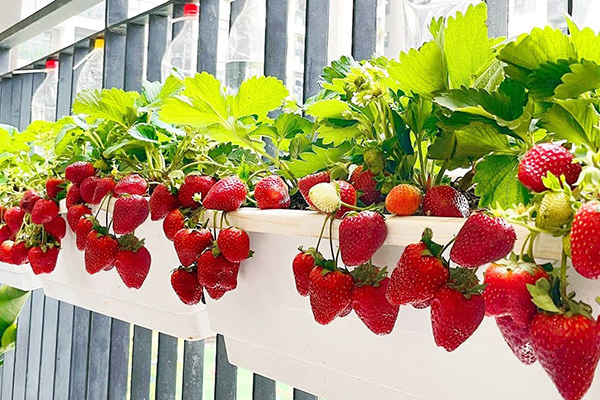
TOP-5 varieties for the windowsill:
| Variety | Type | Features |
|---|---|---|
| Albion | Remontant | Productive, berries are dense, sweet |
| Home delicacy | Remontant | Compact bushes, suitable for small pots |
| Tristar | Semi-remontant | Shade-tolerant, can be grown on northern windows |
| Moscow delicacy | Remontant | Early fruiting, rich taste |
| Rügen | Ordinary | Small but very aromatic berries, decorative appearance |
Planting methods strawberries
There are three ways to grow strawberries at home, and each has its own characteristics. The choice depends on how quickly you want to get the harvest and how much effort you are willing to put in.
From seeds.This is the longest, but most interesting method. The seeds are first soaked for 2-3 days in a damp cloth, then sown in loose soil without deepening. The first shoots appear in 2-4 weeks, and fruiting will begin only after 4-6 months. Suitable for patient gardeners.
Pros:
-
Cheap (a packet of seeds costs a little).
-
You can grow rare varieties.
Cons:
-
Long period until harvest.
-
Not all seeds germinate.
From the whiskers.If you or someone you know has an adult strawberry bush, you can root its shoots (whiskers). Choose the strongest tendril, pin it to the ground in a separate pot, and after rooting (in 2-3 weeks) cut it off from the mother plant.
Pros:
-
Fast (harvest in 2-3 months).
-
Varietal qualities are preserved.
Cons:
-
You need an adult healthy bush.
From ready-made seedlings. The easiest option is to buy young bushes in a nursery. They are planted directly in pots, and with proper care, the first berries can appear in 1-2 months.
Pros:
-
Very fast fruiting.
-
Minimum effort.
Cons:
-
Higher cost.
-
Risk of buying bolnoe plant.
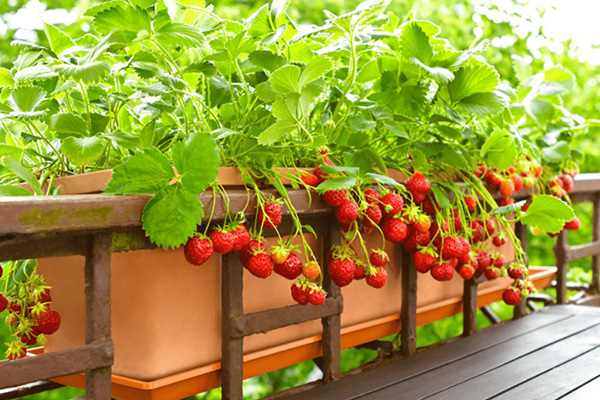
Advice: For beginners, it is better to start with seedlings or whiskers - this way you will see the result faster and will not be disappointed!
Conditions and care for indoor strawberries
Growing strawberries at home requires creating comfortable conditions that are as close to natural as possible. With proper care, the bushes will actively bear fruit and delight you with sweet berries.
Ideal conditions
-
Lighting: 12-14 hours a day. On northern windows, additional lighting with a phytolamp (40-50 W per 1 sq.m.) will be required.
-
Temperature: +18...+25°C during the day, +15...+18°C at night.
-
Humidity: 60-70%. In winter, when the heating is on, spray the leaves or use a humidifier.
-
Pots: Volume 3-5 l with drainage holes. It is better to choose wide, shallow containers.
Basic care
-
Watering:
-
The soil should be moist, but not wet.
-
Use settled water at room temperature.
-
Water at the root, avoiding contact with the leaves.
-
-
Feeding:
-
During the growth period - once every 2 weeks with complex fertilizer (NPK 10-10-10).
-
During flowering and fruiting - potassium-phosphorus compounds.
-
-
Pollination:
-
Indoors, pollinate flowers with a soft brush or shake the bushes.
-
-
Pruning:
-
Remove dry leaves and excess tendrils (if you do not plan to propagate the plant).
-

Important! Once every 2-3 years the bushes need to be renewed, as the yield decreases. To prolong fruiting, remove the first flower stalks from young plants.
Harvesting
With proper care, the first berries appear in 2–4 months after planting, depending on the growing method.

When to expect the harvest?
-
From seeds– in 5–6 months
-
From runners/seedlings– after2–3 months
-
Remontant varieties– bear fruit inwaves(every1.5–2 months)
How to extend fruiting?
- Regular harvesting– pick berries immediately after ripening to stimulate new ovaries.
- Feeding– after harvesting, apply potassium-phosphorus fertilizers.
- Supplementary lighting in winter – extends the period fruiting.
- Pruning old leaves improves ventilation and growth of new flower stalks.
Storing the harvest
-
Store fresh berries in the refrigerator for 2–3 days(unwashed, in a container).
-
For long-term storage, freeze or grind with sugar.
Advice: If the berries are small and sour - increase the lighting and feed with potassium!
Common mistakes and how to avoid them
Even experienced gardeners sometimes face problems when growing strawberries at home. Let's look at the most common mistakes and how to solve them.
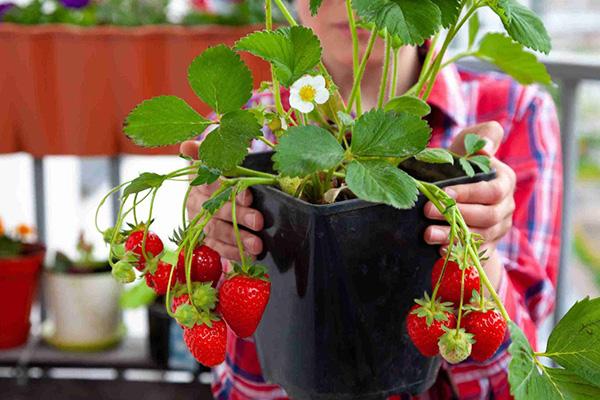
1. Why are there no flowers or berries?
-
Lack of light– strawberries need at least12 hoursof bright light daily.
-
Excess nitrogen– causes leaf growth at the expense of flowering.
-
Plants too young– some varieties bloom only in the2nd year.
Solution:
-
Organize additional lighting phytolamp.
-
Usephosphorus-potassium fertilizers to stimulate flowering.
2. Leaves turn yellow – what to do?
-
Overwatering – the roots begin to rot.
-
Chlorosis – a lack ofiron or magnesium.
-
Dry air– especially in winter when the radiators are running.
Solution:
-
Let the soil dry outbetween waterings.
-
Spray the leaves withiron chelate.
-
Place acontainer of waternearby to humidify the air.
3. Strawberries don't grow or are wilting
-
Tight pot – the roots have nowhere to develop.
-
Root diseases – fungi due to stagnant water.
-
Pests – spider mites or aphids.
Solution:
-
Transplant into a pot of 3-5 liters.
-
Treat Fitosporin from fungi.
-
For pests, use soap solution or biological products.

Important! Most problems can be solved by normalizing care – proper watering, light and fertilizing. Don't rush to throw away the plant - it can often be revived!
Conclusion
Growing strawberries on a windowsill is a fascinating experiment that anyone can do! As you can see, the main secrets of success are simple: the right variety, sufficient lighting and regular care. Yes, it may seem difficult at first, but in a few months you will be able to pick your own sweet berries without leaving your home.
Remember:
-
Start with proven remontant varieties
-
Don't forget about additional lighting in winter
-
Follow the watering and fertilizing regime
-
Don't be upset by the first failures - this is valuable experience
The main advantage of home growing is that you get environmentally friendly berries all year round. And what a delight children have when they see real strawberries ripening on an ordinary windowsill!
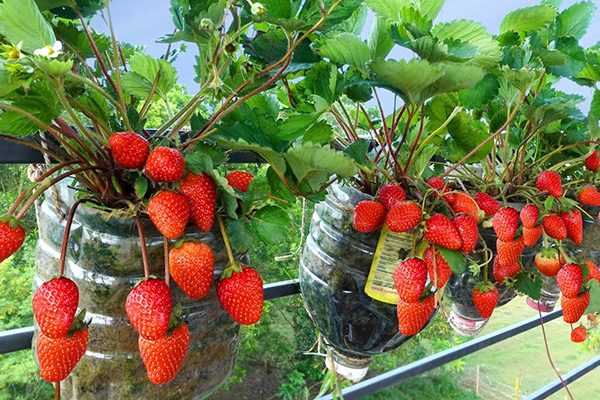
Try it - and you will see that it is really easier than it seems. In just one season, you will become a real expert in home gardening. And perhaps you will get so carried away that you will want to expand your mini-garden with other berries!
FAQ: Answers to frequently asked questions
When is the best time to plant strawberries at home?
The ideal time is early spring (March-April) or late summer (August). During these periods, natural light is optimal for rooting. But with additional lighting you can plant all year round.
Will strawberries grow on a north-facing window?
Yes, but only shade-tolerant varieties (Tristar, Alexandrina). However, the harvest will be more modest — be sure to use phytolamps (12-14 hours of light daily).
Why are the berries small and sour?
Main reasons:
-
Lack of light
-
Excess of nitrogen fertilizers
-
Too high temperature (above +28°C)
-
Lack of potassium during fruiting
Do strawberries need wintering?
Not for remontant varieties. Regular varieties require a dormant period (1.5-2 months at +5...+10°C with reduced watering). After that, they bear fruit more abundantly.
How to deal with aphids on home strawberries?
-
Mechanically: wash off with a soap solution (10 g of laundry soap per 1 liter of water)
-
Biological products: Fitoverm (according to the instructions)
-
Folk remedies: infusion of tobacco dust or garlic
What to do if mold appears in the pot?
-
Remove the top layer of soil
-
Treat the soil with a solution of potassium permanganate (weak pink)
-
Add charcoal or vermiculite for looseness
-
Adjust watering - the soil should dry out 1-2 cm between waterings
Preventing problems:
-
Use only disinfected soil
-
Do not allow water to stagnate in the tray
-
Regularly ventilate the room
-
When planting, add wood ash to the soil (1 tbsp per pot)