
Growing mango at home: from seed to fruit
This is a fantastic idea - to grow a mango at home! Although it is a capricious exotic, with the right care you can really get a luxurious tree, and if you are lucky - even fruits! It is important to choose a dwarf variety, germinate the seed correctly and provide warmth, light and humidity. Without grafting, fruiting is unlikely, but for the sake of tropical foliage it is already worth trying! The main thing is patience: the first years of growth are slow. If you are ready for an experiment - go ahead, this is a magical experience!

Is it possible to grow a mango at home?
Yes, a mango can be grown in an apartment, but this will require patience and compliance with the conditions. The tree will be compact, and without grafting, fruiting is unlikely - it is more often grown as an ornamental plant.
Key points:
-
In an apartment - it is possible if you provide warmth (+25…+30°C), bright light and high humidity.
-
Without grafting - if the fruits appear, then in 6-10 years, and their taste may disappoint.
-
Keeping at home - it is safe, but keep in mind: mango leaves are large, and over time it will need space.
The main thing is to prepare yourself for a long process. Mango grows slowly, but its glossy leaves look exotic and will decorate the interior!
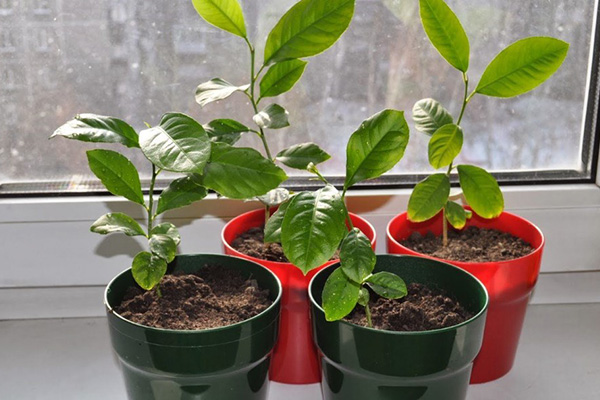
What varieties of mango are suitable for growing at home?
For home growing, it is better to choose dwarf or low-growing varieties of mango - they are more adapted to indoor conditions and do not grow too large. If you want to achieve fruiting, you should pay attention to grafted plants - they enter the fruiting phase earlier and give a more predictable harvest.
The best varieties for home:
-
Curry (Carrie) - a compact tree with fragrant sweet fruits.
-
Palmer (Palmer) - grows well in a pot, the fruits are elongated.
-
Kent (Kent) - a stable variety with juicy fruits, suitable for beginners.
-
Alphonso (Alphonso) - a royal variety, but requires more care.
If you grow from a seed, keep in mind that the varietal characteristics may not be preserved. But even a "wild" can become a beautiful green pet!
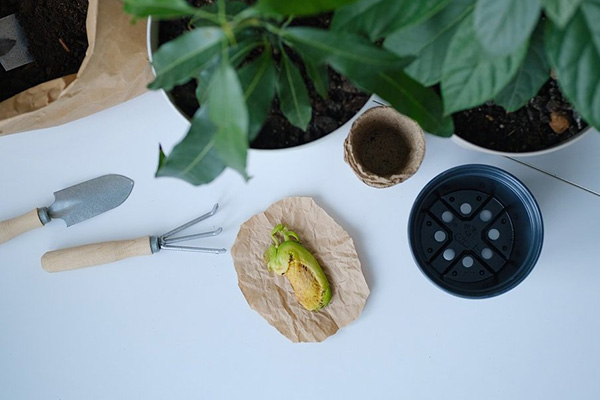
How to germinate a mango seed at home
Germinating a seed is the most important stage, because it depends on it whether the embryo will wake up. A fresh seed from a ripe fruit germinates best. The main thing is not to let it dry out and prepare it for planting properly.
Germination methods:
-
Closed method (in a damp napkin)
-
The cleaned seed is wrapped in damp gauze, placed in a container and kept warm (+25…+28°C).
-
The sprout appears in 2–4 weeks.
-
-
Open method (partial immersion in water)
-
The seed is placed with the blunt end in water by 1/3, secured with toothpicks. Change the water every 2 days.
-
Germination takes 3-5 weeks.
-
How long to wait for seedlings?
If the seed does not hatch for more than 1.5 months, it is probably not viable. Scarification (careful filing of the shell) and bottom heating will help speed up the process. After roots 2-3 cm long appear, the seed is planted in the soil.
Choosing soil and a pot for mango
Mango needs light, breathable soil with good drainage - stagnant water is detrimental to its roots. The ideal option is a mixture for citrus or palms with the addition of perlite (2:1). You can make up the substrate yourself: leaf soil + peat + coarse sand (2:1:1).
Pot selection criteria:
-
Material– ceramics are preferable: it is stable and allows air to pass through. Plastic is acceptable, but requires careful watering.
-
Size– a pot with a diameter of 10–12 cm is suitable for the first planting. With each transplant, increase the volume by 5–7 cm.
-
Drainage– is a must! Place 3–4 cm of expanded clay or broken brick on the bottom.
Mangoes are sensitive to transplantation. Transplant the plant without destroying the soil lump, and only during the period of active growth (spring-summer). The first 2-3 years, replanting will be required annually, adult trees - once every 3 years.

Correct planting of a sprouted mango seed
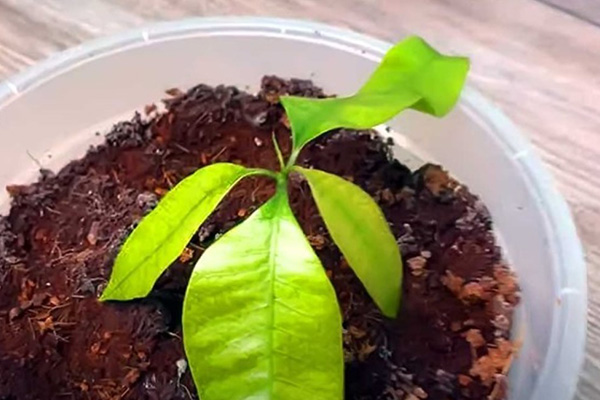
After the appearance of strong roots 3-5 cm long, you can start planting. It is important to do this carefully so as not to damage the delicate sprouts. The seed is placed in the soil horizontally, leaving 1/4 of it above the soil surface - this will prevent rotting.
Step-by-step planting process:
-
Fill the prepared pot with moist substrate, without compacting it.
-
Make a small depression and place the seed with its roots down.
-
Sprinkle with soil, lightly tamp and water with warm, settled water.
Features of mango growing at home:
-
The first shoots appear 2-4 weeks after planting.
-
In the first year, the tree grows slowly, gaining only 20-30 cm.
-
Active growth begins in the 2-3 year - with good care, the plant can add up to 1 meter per year.
For successful development, immediately after planting, provide the plant with stable heat (+25 ... +30 ° C) and diffused light. The first months are especially important for the formation of a strong root system.
How to care for mango at home
Mango is a tropical plant that requires special conditions of maintenance. With proper care, the tree will grow actively and retain its decorative appearance all year round.
Basic care rules:
Watering and humidity
-
Water only after the top layer of soil has dried out by 2-3 cm
-
Use warm, settled water (+30...+35°C)
-
Maintain humidity at 70-80% using a humidifier or a tray with wet pebbles
Feeding. From March to October, fertilize every 2 weeks:
-
Young plants (1-3 years) - complex fertilizers with nitrogen
-
Adult trees - phosphorus-potassium compounds
-
In winter, reduce feeding to once a month
3. Lighting and temperature
-
Provide bright diffused light 12-14 hours a day
-
Optimum temperature: in summer +25...+30°C, in winter not lower than +18°C
-
Protect from drafts and sudden temperature changes
4. Pruning and shaping
-
Pruning is done when the plant reaches 1-1.5 m in height
-
Remove weak shoots and those growing inward
-
Pinch off the tops to stimulate branching
-
The best time for pruning is early spring
Regularly inspect the plant for pests (spider mites, scale insects) and treat with insecticides at the first signs. Once a month, give the mango a warm shower, after covering the soil with a film.
| Aspect | Recommendations | Notes |
|---|---|---|
| Germination |
|
Fresh seeds germinate better. Scarification speeds up the process. |
| Soil | Light, breathable substrate for citrus or palms + perlite (2:1) | Drainage is required (3-4 cm of expanded clay). |
| Pot | Ceramic, with drainage holes. Initial diameter – 10-12 cm. | Replant every 1-3 years with a pot increase of 5-7 cm. |
| Watering | After the top layer of soil dries by 2-3 cm. Only with warm water (+30°C). | Reduce watering in winter. Overwatering is dangerous due to root rot. |
| Humidity | 70-80%. Use a humidifier or a tray with wet pebbles. | Spray the leaves 2-3 times a week. |
| Lighting | Bright diffused light 12-14 hours/day. In winter – additional lighting with a phytolamp. | Direct sun can burn the leaves. |
| Temperature | Summer: +25...+30°C, winter: not lower than +18°C. | Sharp changes and drafts are unacceptable. |
| Feeding | March-October: every 2 weeks. Winter: once a month. | Young plants – nitrogen, adult plants – phosphorus-potassium fertilizers. |
| Pruning | Formation of the crown in spring. Pinching the tops for branching. | First pruning – at a height of 1-1.5 m. |
| Fruiting | Without grafting – after 7-10 years (notguaranteed). With grafting - in 3-4 years. | Dwarf varieties bear fruit more often. Artificial pollination is required. |
| Main problems |
|
Regular inspection and quarantine of new plants reduce risks. |
When to expect mango fruits at home?
Fruiting of mango grown from a seed is a rare occurrence at home. Most of these plants without grafting either do not bear fruit at all, or the first fruits appear after 7-10 years. However, with proper care and favorable conditions, the chances of getting a harvest increase significantly.
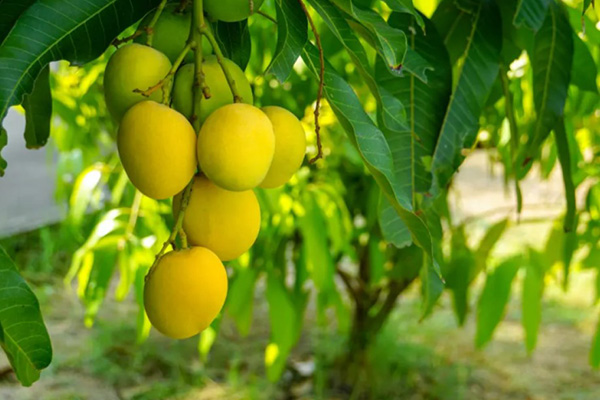
Factors affecting fruiting:
-
Grafting is the only guaranteed way to get fruits in 3-4 years
-
Plant variety — dwarf varieties bear fruit more readily
-
Maintenance conditions — lighting, temperature and humidity
-
Plant age— minimum age for flowering is 6-7 years
If the mango has blossomed:
-
Blooming lasts 2-3 weeks
-
For fruit set, artificial pollination with a soft brush is required
-
After the ovary has formed, leave no more than 2-3 fruits on the young plant
-
Ripening lasts 3-5 months
Unripe fruits can ripen at room temperature for a week. Mangoes that are fully ripe on the tree have the best taste, but this is rare at home. Even if your tree does not bear fruit, its luxurious crown will become a worthy decoration of the interior.
Problems in growing mango and their solution
Even with careful care, mango can face various difficulties. Most of the problems are associated with a violation of the conditions of maintenance. Let's consider the most common of them.
1. Leaf fall
-
Reasons: hypothermia, drafts, sudden change in lighting
-
Solution: gradual adaptation to new conditions, maintaining a stable temperature
2. Dry leaf tips
-
Causes: low air humidity, excess fertilizers
-
Solution: regular spraying, installing a humidifier, reducing fertilizing
3. Pests
-
Main enemies: spider mites, scale insects, mealybugs
-
Control methods: treatment with soap solution, use of insecticides (Fitoverm, Actellic)
4. No growth
-
Causes: lack of light, poor soil, cramped pot
-
Solution: replanting into fresh substrate, organizing additional lighting with a phytolamp
5. Root rot
-
Causes: overwatering, heavy soil
-
Solution: emergency replanting with removal of damaged roots, treatment with fungicide
To prevent problems, regularly inspect the plant, follow the watering and fertilizing schedule, maintain optimal air humidity. Remember that mango tolerates mild drought better than overwatering. At the first signs of disease, isolate the plant from other indoor flowers.
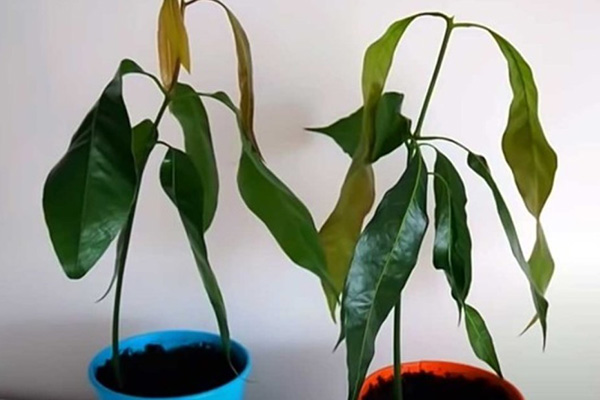
Growing mango at home is a fascinating experiment with the tropics
Growing mango from a seed is an exciting process that will give you not just a plant, but a real tropical pet. Even if you fail to get fruits, the tree itself with its glossy foliage will become an exotic decoration for your home.
The main advantages of this plant:
-
Unusual appearance, reminiscent of the tropics
-
Relative unpretentiousness if you follow the basic rules
-
The ability to observe the entire development cycle - from the seed to the tree
-
Useful experience in growing exotic crops
Don't be afraid to experiment! Every successful case of home mango fruiting once began with an attempt. Even professional gardeners started with the first seed. Your patience and care will definitely yield results - perhaps not always in the form of fruits, but certainly in the form of invaluable experience and aesthetic pleasure.