
How to Grow Ginger at Home: Step-by-Step Instructions for Beginners
Introduction: the benefits of ginger
Ginger is not just a fragrant spice, but also a real superfood with a lot of useful properties. It strengthens the immune system, improves digestion and even helps fight inflammation. Growing it at home is a great way to always have fresh root on hand without chemicals.

Why is it worth trying?
-
Saving: store-bought ginger is often treated with preservatives.
-
Simplicity: the plant is unpretentious, even a beginner can handle it.
-
Aesthetics: tall stems with narrow leaves look exotic.
Just a few steps - and you can harvest right on the windowsill. Let's start with the most important thing - choosing the root for planting!
How to choose ginger for planting
Choosing the right root is the first step to successfully growing ginger at home. You want a fresh, healthy specimen with smooth skin and visible buds (eyes) from which sprouts will emerge. The best time to plant is late winter or early spring, when the plant is naturally ready to grow.
Selection criteria:
-
Look for a root with an elastic structure (not wilted or wrinkled)
-
Several live buds should be clearly visible on the surface
-
Avoid specimens with mold or dark spots

When to plant?The best time is February-March, so you can get a harvest by autumn. If you use store-bought root, choose organic - regular root may contain growth inhibitors. Remember: the fresher the ginger, the higher the chances of successful germination.
Preparing ginger for planting
Before planting, the root must be properly prepared - this will significantly increase the chances of successful germination. First, thoroughly wash the ginger under running water, removing all dirt and possible chemical residues. If the root is large, it can be divided into parts - each division should have at least one well-developed bud.
Step-by-step preparation:
-
Soak the root for 2-3 hours in warm water (you can add a weak solution of potassium permanganate for disinfection)
-
Dry in the air for 1-2 hours until a protective crust forms on the cuts
-
To stimulate growth, you can treat the buds with an Epin solution or aloe juice
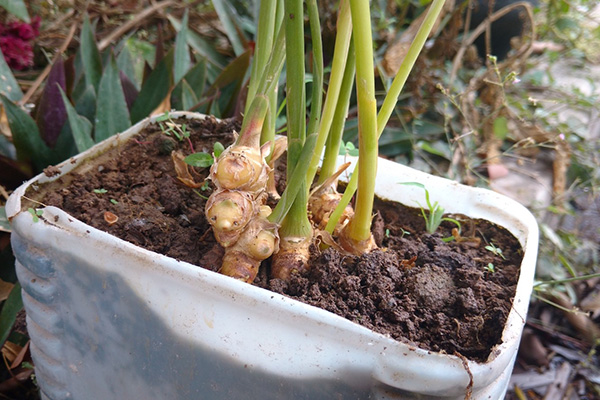
Important nuance: if the buds are inactive, wake them up - wrap the root in a damp cloth and leave it in a warm place (about +25°C) for 2-3 days. As soon as green shoots appear, you can start planting. Do not use overdried or frozen roots for planting - they will not produce viable shoots.
How to plant ginger correctly
Planting ginger requires the right approach to choosing a container, soil and location. A wide and shallow pot (the roots grow horizontally) with mandatory drainage holes is best suited for this exotic plant. Be sure to put 2-3 cm of expanded clay or pebbles on the bottom to prevent water stagnation.
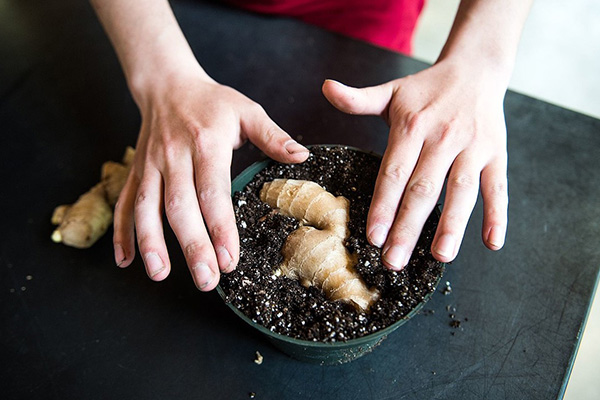
Soil selection:
-
Use a loose nutrient mixture (garden soil + humus + sand in a ratio of 2:1:1)
-
Acidity should be neutral (pH 6.0-7.0)
-
You can add vermiculite to improve the structure
Planting process:
-
Fill the pot with prepared soil, leaving 3-4 cm to the edge
-
Place the root with the buds up, deepening it by 2-3 cm
-
Gently water with warm, settled water
-
Cover with film to create a greenhouse effect

Place the pot in a warm place (+22...+25°C) with diffused lighting. The first sprouts will appear in 2-4 weeks - then the film can be removed. It is important not to over-moisten the soil during this period so that the root does not rot.
Caring for ginger at home
To grow a healthy and aromatic plant, it is important to properly care for theand ginger at all stages of its growth. It is not difficult, but requires attention to the conditions of maintenance, watering and fertilizing.
Suitable conditions
Ginger is a tropical plant, so it loves warmth and humidity. The optimal temperature for its growth is from +22 to +28°C. The plant does not tolerate drafts and sudden changes in temperature, so it is better to keep the pot away from open windows and doors.
Ginger prefers diffused light - a window sill on the east or west side is ideal for it. If you grow it in winter or in a poorly lit room, use phytolamps for additional lighting.
Ginger also needs high air humidity. Regularly spray the leaves with a spray bottle or place a tray of water next to the pot.
Watering and fertilizing
Watering should be regular but moderate. The soil in the pot should always be slightly damp, but not wet. Excess moisture can lead to root rot. It is best to water the ginger when the top layer of soil has dried out by 2-3 cm.

In spring and summer, during the period of active growth, ginger requires fertilizing. Use organic fertilizers or mineral complexes with potassium and phosphorus every 2-3 weeks. In autumn, when growth slows down, feeding is gradually stopped and watering is reduced.
When and how to harvest ginger at home
Ginger is a plant with a long vegetation cycle, and it takes 8–10 months after planting to fully ripen. However, with proper care, you can harvest a fresh, aromatic crop even in an ordinary apartment.
When to harvest ginger
The main guideline is yellowing and drying of the leaves. This is a signal that the roots are fully formed and ready for harvesting. This usually happens closer to autumn, if planting was in the spring. You can harvest ginger earlier - after 5-6 months, but then the roots will be younger, softer and with a more delicate taste.
If you want to get a mature root with a rich aroma and medicinal properties - let the plant grow for at least 9 months.

How to harvest
-
Carefully dig the rhizome out of the pot, trying not to damage it. It is convenient to do this when the soil has dried out a little.
-
Clean the root from the soil and separate the required amount. The remaining part can be replanted if it has live buds (eyes).
-
Rinse the root in water and air dry before storing or using.
After harvesting, you can either let the plant rest by replanting the rhizome in the spring, or continue growing by leaving part of the tuber in fresh soil.

Common problems when growing ginger at home
Even with good care, novice gardeners can face difficulties. Below are the most common problems and how to solve them.
1. Ginger does not germinate
Reason: the root is old, overdried, or has no buds (eyes).
Solution: choose a fresh, dense root with visible "eyes". Before planting, soak it for 12-24 hours in warm water.
2. Leaves turn yellow and wither
Reason: too dry air, lack of nutrients, or the end of the growing season.
Solution: humidify the air, apply fertilizer (if it is the active growth season), or prepare to harvest if 8-10 months have passed since planting.
3. Mold has appeared on the soil
Cause: overwatering, stagnant water or poor drainage.
Solution: reduce watering, make sure the pot has drainage holes. Replace the top layer of soil if necessary.
4. Slow growth
Cause: not enough light or heat.
Solution: move the pot to a warmer and brighter place, use supplemental lighting if necessary.
5. Roots have started to rot
Reason: excess water and poor soil ventilation.
Solution: remove damaged areas, treat the cuts with charcoal, transplant the root into fresh, loose soil with good drainage.
Conclusion
Growing ginger at home is not only a useful, but also an exciting activity. It does not require special skills or rare materials, just a little patience, attention and loveand to plants.
Imagine: a real tropical miracle is growing on your windowsill, and in a few months you will be able to harvest your own fresh, aromatic ginger - completely natural and grown with your own hands.
In addition, home-grown ginger is not only a spice, but also a source of health. It strengthens the immune system, helps with colds, improves digestion and gives energy. And the process of growing it brings joy, calms and inspires.
Don't be afraid to try - even if the first time you don't get it perfect. Every step is an experience, and your green pet will definitely please you with its growth and results.
Start today — and very soon a piece of exoticism, grown with care and soul, will appear in your home.
FAQ — Frequently Asked Questions
Is it possible to grow ginger from ginger root?
Yes, that is how it is grown. The main thing is to choose a fresh root with live buds (eyes). If planted correctly, a full-fledged plant will grow from it.
How long does ginger grow at home?
A full growing cycle takes 8–10 months. In 4-6 months, you can dig up the young root, but to get a mature harvest, you should wait longer.
Can I plant ginger in a pot?
Yes, this is the best way to grow it at home. The pot should be wide and shallow, with good drainage and loose soil.
Can I grow ginger in an apartment?
Of course. The main thing is to provide warmth, diffused light, and moderate humidity. Ginger feels good on a windowsill or in a warm corner of the room.
How long does it take for ginger to sprout from the root?
The first sprouts appear in 2-4 weeks if the root is fresh and properly prepared (soaked, planted in warm, moist soil).
Can I plant store-bought ginger root?
Yes, but choose unprocessed root, without signs of mold and with live buds. It is advisable to buy it in organic stores or markets.
How to store the ginger harvest?
The root can be stored in the refrigerator (in a paper bag or container), in a dry, cool place, or frozen. Ginger also keeps well in powder or pickled form.
Why do ginger leaves turn yellow?
This may be a natural wilting process before harvesting. If this happens ahead of time, check the humidity level, the presence of drafts and the quality of the soil.
Do I need to trim the ginger?
Trimming the stems is not necessary. If the leaves have dried out or started to rot, carefully remove the damaged parts so as not to interfere with growth.
Can I grow ginger on the balcony?
Yes, if the balcony is warm and protected from the wind. It is important to monitor the temperature: below +15°C, growth slows down. In autumn, it is better to bring the plant indoors.
Why does ginger not germinate?
Often the reason is an old or over-dried root, too dense soil, cold or excess moisture. Choose high-quality planting material and create warm, humid conditions.